The choice depends on your business and what you need your website to do.
A gardening blog probably doesn’t need a custom WordPress theme. An online store, however, might benefit from one if it has hundreds of products, complex features, and a specific brand experience. The customization gives the business more control over its design and functionality.
That said, there are many other factors to consider, including your budget, timeline, design requirements and how much control you want over the site. We’ll compare custom themes and page builders across these areas to help you decide which approach fits your business.
Custom Theme vs. Page Builder: How Do They Compare?
A custom theme gives you more control, but it takes more time and resources to build. A page builder, on the other hand, gets your site running faster while introducing its own limitations. The sections below compare the main trade-offs between the two approaches.
Cost
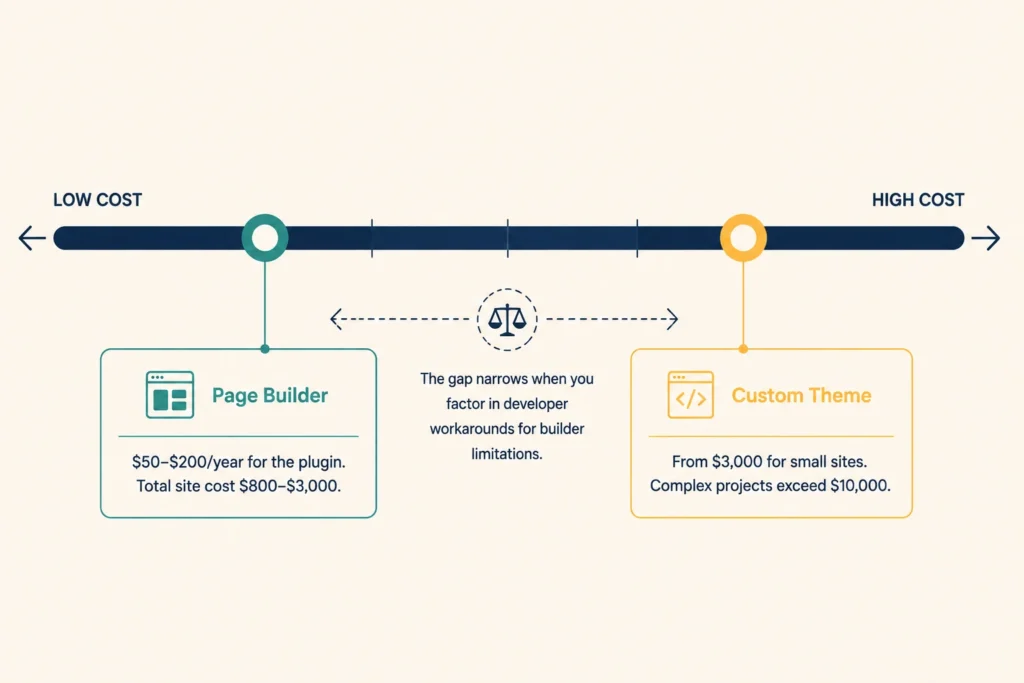
Cost-wise, page builders are usually the cheaper option. Here’s what you might expect to pay for each one.
- Page Builder: A page builder plugin or platform might cost $50 to $200 per year. A small business site built with one typically costs around $800 to $3,000 in total, depending on the design and development work involved.
- Custom Theme: A small custom site starts around $3,000, with complex projects exceeding $10,000.
The difference comes from the amount of development work involved. A page builder provides many of the design tools and components upfront, while a custom theme requires a developer to build those elements around your requirements.
Time to Build
You can launch a new site with a page builder in as little as 1 to 4 weeks. Most builders come with ready-made templates, sections, and content blocks, so you don’t have to build the layout from scratch. This is why page builders are considered beginner-friendly, and it’s part of why sites launch faster too.
By comparison, a custom theme requires a developer to build the site’s layouts and functionality specifically for your business. They’ll also need to design the pages, write the code, test everything, and make revisions before launch. From our experience, it takes about 6 to 12 weeks to create a custom site and get it live.
Design and Functionality
Say your business needs a booking form with custom logic, like showing different fields depending on the service someone selects. A custom theme gives a developer the freedom to write custom code and build those features to match exactly what your business needs. The same applies to more complex integrations, such as connecting a booking system to your inventory.
Page builders handle smaller needs well. Most offer ready-made contact forms, landing pages, and other common elements, so you can build a professional site without custom development. But once you need advanced features beyond what the builder and its plugins provide, your options become more limited.
Performance
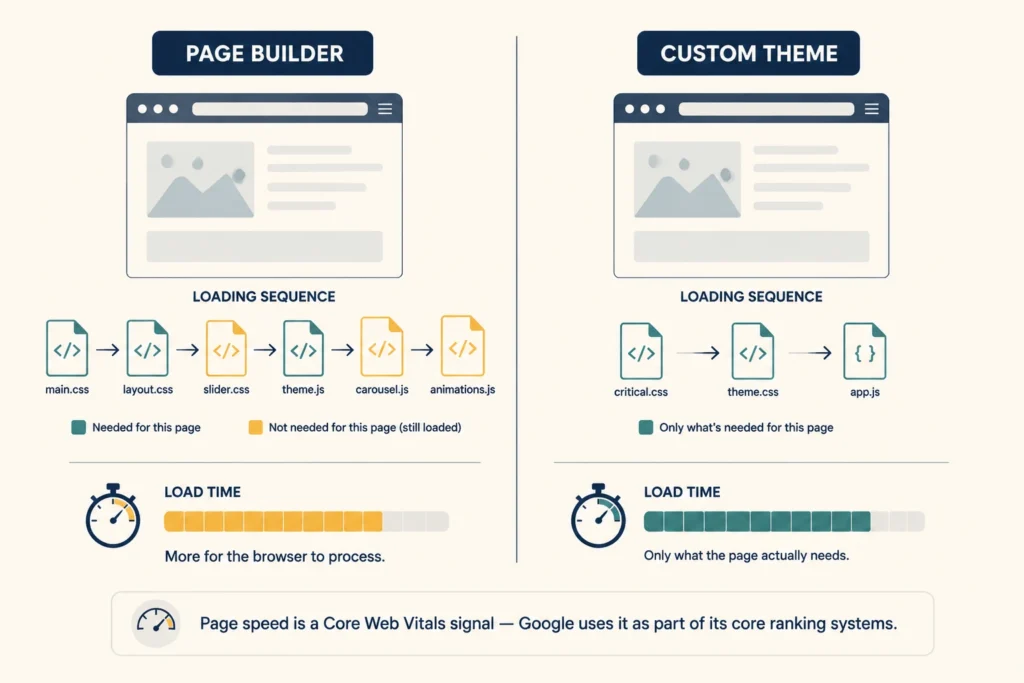
Performance depends on how much work the browser does before a page loads. With a well-built custom theme, a developer controls which code and features load on each page. This means avoiding code your site doesn’t actually need.
By contrast, page builders rely on prebuilt components and often load extra CSS and JavaScript to support their features. Some of that code might not be needed on every page, giving the browser more to process and potentially slowing the page down. Of course, a well-optimised page-builder site can still load quickly, but developers have less control over what the builder loads.
Page speed also plays a role in SEO. Google Search Central states that Core Web Vitals are one of the signals its core ranking systems use to evaluate pages. Faster pages also create a better experience for visitors, who are less likely to leave while a page loads.
Maintenance and Updates
WordPress and plugin updates don’t always play nicely with an existing site. An update might break a button, distort a page layout or stop a feature from working. If you need to fix these issues with a custom theme, you’ll usually need a developer.
The code was built specifically for your site, so someone needs to understand how it works before making a safe fix. A page builder gives you more room to handle minor changes yourself. You can update many themes and plugins from the WordPress dashboard and use the builder’s visual controls without touching code.
That doesn’t make page builders maintenance-free, though. An update can still cause plugin conflicts or break custom functionality, which might still need one to fix. You simply have more control over routine changes and minor fixes.
Custom themes therefore tend to require more developer involvement after launch. If you choose one, factor that ongoing work into your maintenance budget.
Which Option Is Better for Your Business?
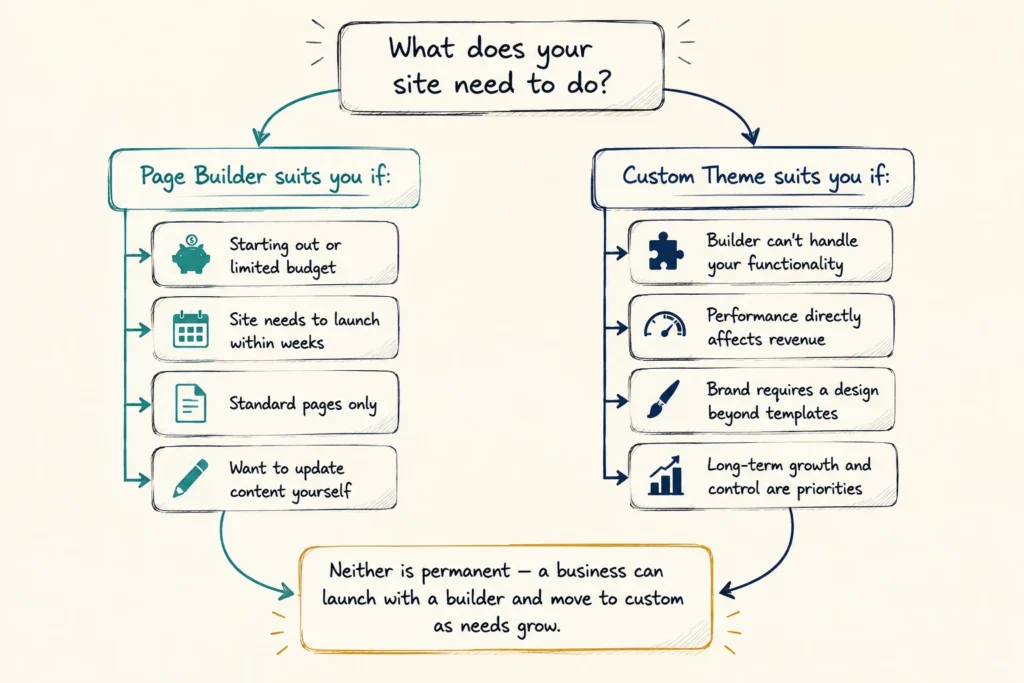
The decision comes down to two questions: what does your site need to do now, and where does your business need it to be in two years?
A page builder suits your business if:
- You’re starting out or working with a limited budget
- The site needs to go live within a few weeks
- Your site only needs standard pages such as home, services, about and contact
- You want to make minor content updates yourself through a user-friendly dashboard, without calling a developer
A custom theme suits your business if:
- A builder can’t cleanly handle the functionality your site needs
- Performance has a direct impact on revenue if the site generates sales
- Your brand requires a design that doesn’t fit neatly into a template
- Long-term business growth is the priority, along with more control over how the site develops
That said, you don’t have to make the choice permanent. A business might launch with a page builder and move to a custom build later as its needs become more complex. That’s a perfectly reasonable path.
The problem is this: choosing a page builder because it’s cheaper, then spending the next two years paying a developer to work around its limitations. If your requirements are already complex, the cost difference between a builder and custom theme can narrow quickly once you factor in those workarounds.
The best choice, then, isn’t necessarily the cheapest option today. It’s the one that fits what your business actually needs without creating unnecessary costs later.
Making the Right Call for Your Website
Neither approach is automatically better. The right one is whichever option gives your business what it needs without adding unnecessary cost or complexity. Think about what your site needs today and what you might need it to handle as the business grows.
Still not sure which one fits? DPRConference builds websites with both custom themes and page builders. We can help you choose the right setup based on your requirements, budget, and long-term plans. Get in touch for a free consultation.